Understanding the real difference between an online public auction and a dealer-only auction can directly affect what you pay, how you bid, and your level of protection. In Australia, both formats are widely used by automotive dealerships, wholesalers, and private buyers.
With the rise of online bidding, access to auctions has expanded but so has confusion. If you’ve ever wondered what the difference between bidding and auction is, or how public auction differs from dealer-only auctions, you’re not alone. This guide breaks down the distinctions, explains how each format works, and offers practical tips for auction buyers and sellers.
What’s the Difference Between Bidding and Auction?
An auction is the structured sale process itself. A vehicle goes up for sale, bids are placed within a set timeframe, and the highest bidder (above any reserve price) wins it.
Bidding is the act of offering a price during that process. You can bid in person, by phone, or through online bidding platforms depending on the format and the auction house running the sale.
Think of it this way, the auction is the event, and bidding is how you participate in it.
Online bidding has changed the game considerably. Buyers across Western Australia can now compete for vehicles without setting foot in a physical auction yard. This has opened up access to cars that were once limited to those who could be there in person.
Open to the Public Auction vs Dealer-Only Auction
This is where most buyers get confused and where the distinction really matters.
Open to Public Auction
A public auction is an open, competitive sale where registered buyers bid on vehicles and the highest bid wins. No haggling. No inflated sticker prices. Just transparent, real-time competition.
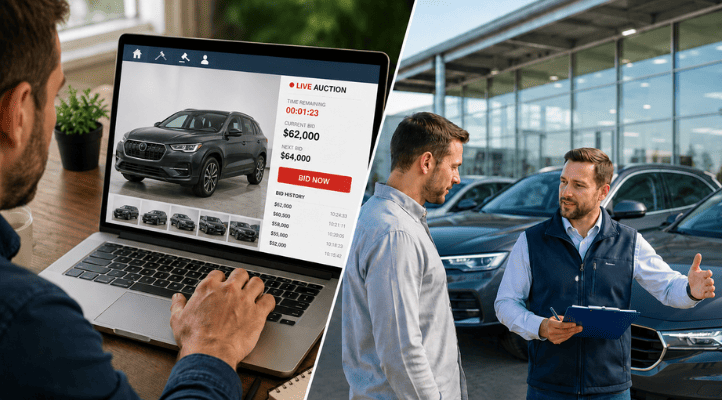
At Mil & Co Auctions, the process is fully online. You register, browse the vehicle listings, inspect condition reports, and place your bids — all from your phone or computer. When the auction closes, the highest bidder above the reserve price wins the vehicle.
Bidding is simply the act of offering a price in competition with other buyers. Each bid is visible, each increment is clear, and the result is determined by the market not a salesperson’s commission target.
Dealer-Only Auction
A dealer-only auction restricts bidding to licensed automotive dealers. If you’re not affiliated with a licensed dealership, you simply can’t bid. These auctions are where automotive dealerships source inventory, offload trade-ins, move aged stock, or pick up off-lease returns.
The environment is more competitive and fast-paced. It’s built for professionals who know what they’re looking at and are buying to resell. Condition reports are still available, but the emphasis is on efficiency and volume not buyer hand-holding.
Who Can Participate and How
| Public Auction | Dealership | |
| Who sets the price | Anyone (registered) | Licensed dealers only |
| Price transparency | Full — all bids visible | Limited — sticker price + negotiation |
| Buyer’s premium | Yes, buyer’s premium applies | No, but margin is built into the price |
| Vehicle range | Diverse — trade-ins, fleet, private | Curated — dealer-selected stock |
| Pressure to buy | None | Often high |
| Negotiation | Not applicable — bidding decides | Yes, but dealer holds the advantage |
| Statutory warranty | Generally as-is | Yes — required by Australian Consumer Law for licensed dealers |
| Online access | Yes — bid from anywhere in WA | In-person or enquire online |
| Inspection opportunity | Condition reports + preview days | Test drives available |
Where Public Auctions Win
1. The Price Is Set by the Market, Not a Margin
Dealerships buy vehicles cheaply, often at dealer-only auctions then mark them up for retail. That margin funds their overheads: showroom floor space, sales staff, advertising.
At a public auction, you’re effectively buying closer to what a dealer would pay. The hammer price reflects genuine demand, not a retail markup.
2. Full Price Transparency
When you bid at Mil & Co Auctions, you see exactly what others are offering. There’s no mystery about whether you’re overpaying. The buyer’s premium is disclosed upfront, so your total cost is calculable before you commit.
At a dealership, the “price” is just the opening position. Finance packages, add-ons, and trade-in valuations can all quietly shift the real cost in the dealer’s favour.
3. No Sales Pressure
Auction bidding has a natural cut-off, the auction closes, and that’s that. There’s no salesperson following up, no urgency tactics, and no obligation to buy if the price goes beyond your budget. You set your maximum, and the process does the rest.
4. Access to a Wider, More Diverse Range of Vehicles
Auction stock comes from trade-ins, fleet disposals, off-lease returns, deceased estates, and private sellers. That variety means you’re more likely to find something unusual, well-priced, or hard to source through a dealership.
Where Dealerships Have the Edge
Statutory warranty protection. Under Australian Consumer Law, licensed dealers must provide consumer guarantees on vehicles. At a public auction, vehicles are generally sold “as-is.” This makes pre-auction inspection and due diligence non-negotiable.
Test drives. You can drive the car before you buy. At an auction, you’re working from condition reports, photos, and preview inspections — not a test drive around the block.
Finance arranged on the spot. Many dealerships offer in-house finance. Auction buyers typically need their finance sorted beforehand.
After-sales support. Dealers often provide servicing, spare parts, and a direct point of contact post-purchase. An auction is a one-transaction relationship.
What to Do Before You Bid at Mil & Co Auctions
Since auction vehicles are sold as-is, your preparation before bidding is everything.
- Read the condition report thoroughly. Mil & Co Auctions provides detailed reports on listed vehicles. Read every line.
- Run a PPSR check. For around $2, you can confirm there’s no finance owing on the vehicle and it hasn’t been written off. Do this before bidding, not after.
- Attend the preview day if you can. Photos don’t show everything. Getting eyes on the vehicle or sending a trusted mechanic is worth the effort.
- Know your total budget. Add the buyer’s premium and any transport costs to your maximum bid. That’s your real ceiling.
- Sort your finance first. Unlike a dealership, you won’t be arranging a loan at the auction. Have your funding ready before you win.
Who Should Consider an Online Public Auction?
Buying at an online auction through Mil & Co Auctions makes particular sense if you:
- Know what you want and have done your research
- Want to avoid inflated retail pricing
- Are comfortable doing due diligence on a vehicle before purchase
- Value transparency over convenience
- Are looking for variety beyond standard dealership stock
If you’re a first-time buyer who needs hand-holding, a warranty guarantee, and a test drive, a dealership may be the safer starting point. But for savvy buyers? The savings and selection at auction are hard to beat.
Conclusion
A dealership offers convenience and consumer protections. A public online auction — like Mil & Co Auctions offers transparency, competitive pricing, and access to a broader range of vehicles without the retail markup.
Neither is wrong. But knowing the difference means you can make the choice that suits your situation not the one that suits someone else’s commission.
If you’re ready to buy smarter, we’d love to help. Call us on 08 6374 7105 or get in touch with Mil & Co Auctions today! Browse our latest listings and bid smart!